
Navigating Special Occasions Without Alcohol

When you’re considering sobriety longer term, there’s a few things that can cause concern. These tend to be upcoming special events, holidays or celebrations. You may be worried about planned time away or those occasions where alcohol used to be the default setting. So today I want to talk about how to function in these situations without alcohol dictating your thinking so that you can open up to the possibility of doing this for a longer period of time.
People often imagine events like weddings, parties or holidays will feel awkward, and actually, once you can get some structure and confidence in not drinking, you’ll find that you can enjoy them in a different way. It’s the anticipation that causes the problem, not the event itself.
Let’s break all of them down properly. The first thing is to understand that when you’re considering events without alcohol, it’s mostly about the pressure you feel before the event, and often not what you’re feeling during it.
Nights out
Almost everyone is imagining that there will be drinking pressure from others the moment you’re at the bar, at a dinner table or at a party. But for most people, the tension they’re feeling is actually before the event, when you’re trying to work out what you’re going to say to people, when you worry about being questioned, or imagine that you’ll feel out of place. It’s all storytelling, wondering whether you’ll feel bored or assuming everybody else is going to be drinking heavily or anticipating judgment that rarely happens. And the mind that’s storytelling and building a version of the event that isn’t accurate doesn’t help you, because when you’re actually in the event, there’s a few predictable things that happen. People are often more focused on themselves and what they’re drinking than what you’re drinking. Your first 10 minutes at any event will feel unfamiliar, then it will normalise, and conversations don’t tend to hinge on alcohol, unless you’ve chosen poor company.
Another thing that’s clearer is that you’ll begin to notice when people start repeating themselves. There’s no denying that this tends to happen later in the evening, and you’ll feel a lot more present. So you may notice a bit of restlessness, but that’s why planning matters. Because in preparation, you’re removing any unnecessary mental noise that could destabilise you.
Keep in mind the three drink rule that I’ve mentioned in previous articles. There’s a point in every event where the social energy will change, and that’s when people have crossed that line where their behaviour shifts with drinking. What began as normal conversation and people being in quite a stable mood and self aware, all of a sudden shifts. Maybe they have louder voices and they’ll tell the same story more than once. You may notice they have sloppier boundaries and a decreased awareness of how you’re experiencing things, so you might feel more pressure to join in with them but don’t be swayed.
You can notice it, but you don’t have to do anything about it. Just notice that the quality of the event has now shifted slightly. So you’ve got three options at this point:
You can stay and watch and observe, which is useful for short events like an evening out.
You can move to a quieter pocket of the venue. That’s useful if you’re at something like a wedding.
Or you can leave early.
You can choose what you do according to how you feel.
Big Events
So let’s talk about those big events like weddings and birthdays and big parties, and how to make them easier when you’re not drinking, because large events have really predictable patterns.
This is an area I do have a lot of experience of because I spent the first 15 years of my working life filming weddings, so I know weddings inside out. I’ve attended 1000s of them and I’ve also done so sober because I was working. And as much as everybody would like to think that their wedding day is different, they do all follow the same structure and the same pattern which will help you. When you understand those patterns, you can handle them without over thinking.
People drink at weddings out of a social structure, and not always out of desire. There is also lots of waiting around and there is quite a lot of boredom for the guests. Drinking is often just a way to pass the time and to ease that boredom. So if you are feeling bored, just know that weddings, if you’re not in the wedding party, can have pockets of boredom to them. It’s not that you’re boring. What you’ll also notice is, after the meal, the pace will change again. That’s when you can either leave the venue and come back for the evening, or you can go to your room, and you can actually step away without anyone noticing at any point, everybody’s far too busy.
And the bonus is with big events like weddings, nobody knows where you are or what you’re doing. You can wander off for a walk to catch your breath. You can just disappear into a different room and ground yourself for a moment. Useful strategies with weddings are to decide in advance which part of the wedding you’re going to go to. So are you going all day or just the evening? You can plan your exit before you arrive.
When you walk into wedding venues, there will be somebody offering you drinks, and they will always have alcohol free options. Don’t panic if you’re offered champagne or prosecco. Don’t forget there will be people driving so stick near people that you know and that make you feel grounded, and not those heavy drinkers who are going to peak early. And if you feel uncomfortable, move location, change rooms, talk to somebody else. When that vibe shifts, you can move away from it.
A Holiday
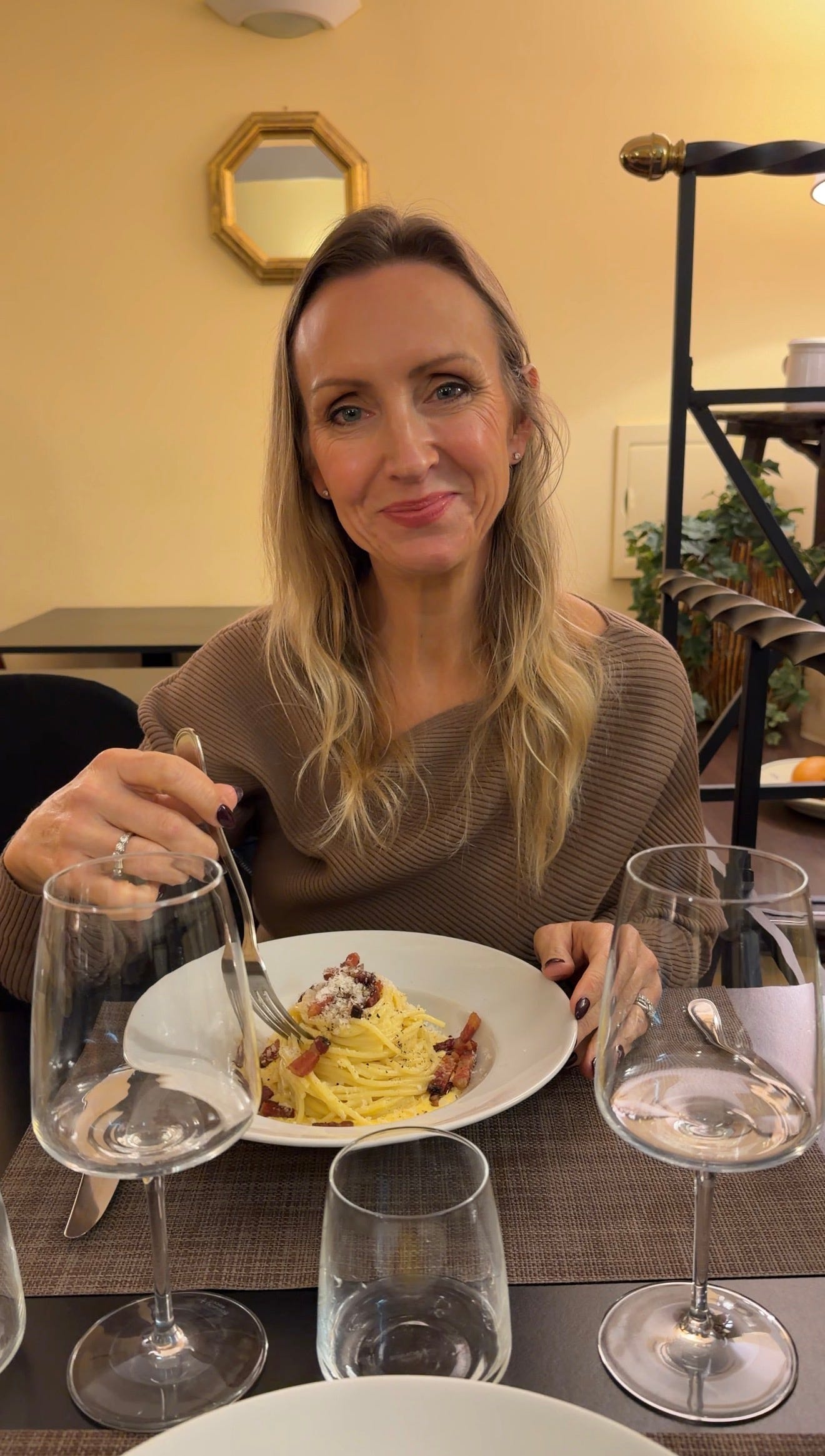
I’m actually writing this from Rome so it’s really fresh in my mind and something I’ll share more about in upcoming articles. Holidaying when sober is a true gift when you give it a proper chance. There’s a lot of associations around drinking on holiday. Holidays for me used to revolve around drinking by the pool, having late nights, long boozy dinners, drinking by beach bars and wine with every meal. You might even have gone all inclusive historically, and feel like you’ve got to get your money’s worth. But here’s the shift. Once you take away alcohol, holidays become easier, and actually, when you think about it, you work hard and you’ve saved up. You’re going somewhere new and relaxing so you want to spend some time in that environment, you want it to feel easy.
A holiday is supposed to be a break from work where you feel like you’re recuperating, recovering and resting, you don’t want it to feel harder. But when you’re drinking, holidays do feel harder, because it’s a constant drip, drip, drip. You’re never fully present. You’re always drinking to recover from the drinking you did the day before. Alcohol will be disrupting your sleep, dehydrating you in a hot climate, it can make you very irritable in heat as well. It can shorten your patience and that will ruin your mornings. It can cause arguments. You can waste days recovering when you’re paying a fortune to go somewhere. It can make your meals actually feel quite heavy and sluggish, and it can feel samey.
I found that holidays felt quite boring towards the end, because they did feel so samey. And this is where I’ve noticed a sober holiday is totally different, because I focus on the mornings instead and I always make sure I’m up early. I like a sunrise walk or going and doing some Pilates or some yoga with the sun rising. I love walking and finding a nearby bakery to get some pastries for breakfast. I’ve got better energy, so I’ll go and find a coffee shop. And what you actually also find is you remember the trip. You enjoy the food properly. You remember what you’re doing. I’m no longer interested in an all inclusive, instead we plan on venturing out and I make sure that we’re properly exploring the area.
The other thing that I find on a sober holiday is that you don’t get that horrible bloating. On a drinking getaway I would always sit by the pool in the afternoon drinking lager, because I didn’t want to be drinking wine too early in the day, and I would end up feeling really tired and sleepy. There’s nothing worse than that feeling, knowing that you’ve then got to go back to the room, get changed, and start on it again that night.
I used to just end up feeling like I was on this treadmill and I would often get to the end of a drinking holiday and just couldn’t wait to get home to start a detox. Well, what a waste of the £1000s that these things cost us. This time, this precious time we’ve looked forward to and saved up for.
Now that I’m sober, I am not dragging myself around. I’m not getting bored. I make sure I’m going to see the area. I make sure I’ve got things to entertain me. I don’t expect to just sit on a sun lounger all day and not do anything, because that is boring and that does bore me. I’m somebody that likes to get up and go to do things and to see things, but I do also then allow myself to have more rest when I need it. I notice those energy ebbs and flows.
To reassure you if you’re nervous, I know that from all the people I’ve spoken to, most people will say that sober holiday’s are their favourite part of sobriety. They love a sober holiday, because you’re not losing anything in this process. You just stop surrendering half your time to hangovers and the other half to feeling sleepy because you’ve drunk too much.
So whatever event you’re going to make sure you know what you’re going to say to people if they offer you a drink, keep it neutral, and keep your tone really firm and strong and matter of fact. And the more matter of fact you are, the shorter the conversation will be. If someone pushes you, then it’s about them and not you, because normal drinkers don’t care what you’re drinking. It’s only uneasy drinkers that question it.
Having an exit strategy whatever the event will make that event easier, so you’re allowed to leave whenever you want. Don’t feel guilty. Don’t wait for somebody else to give you permission, or don’t wait till a certain time or when there’s a natural break in the proceedings. Just leave when the event stops adding value to you. Go home, and actually, most people won’t even notice, because they’re usually too far gone by that point. And if you remove that obligation to stay until the end like you’ve got to prove some sort of point, you’ll be amazed at how freeing that feels.
If navigating sober events is bringing things up for you, whether that’s social anxiety, people pleasing, identity shifts or simply the question of who you are without a drink in your hand, that’s the deeper work I explore inside my online courses.
Sober Resilience is my 21 day psychology based programme designed to help you change your relationship with alcohol in a way that feels grounded and sustainable rather than performative. And for those who recognise that focus, impulsivity or emotional regulation play a role in their drinking patterns, my ADHD Regulation Course blends cognitive behavioural tools with targeted hypnosis to help you work with your nervous system and attention more effectively. Both are designed to support real world sobriety, including the rooms, events and conversations where you once felt you needed alcohol to cope.
If you’d like a session 1:1 with me to talk about sobriety or any other challenges you’re facing that you’d like support with, head to my website and send me an email or message me on here.
Louisa x
About Louisa
Louisa Evans is an accredited UK based practitioner with a background in Cognitive Behavioural Hypnotherapy and a Master’s degree in Psychology. She specialises in helping people change their relationship with alcohol, build self trust and create lasting change through evidence based psychological tools, CBT and hypnosis.
A Senior Member and Registered Supervisor with the ACCPH, and an accredited practitioner with the GHR and GHSC, Louisa has supported hundreds of clients across the world. Her approach blends research led methods with lived experience, having chosen sobriety herself in 2022 after years of exploring the connection between mental health, habits and identity.
Her MSc research focused on alcohol use and menopause, and she is now preparing to begin doctoral research exploring the intersection between alcohol, coping and neurodivergence. You can find out more at www.louisaevans.com or listen to her podcast The Sober Rebel for thoughtful conversations about life beyond alcohol.
All Beyond Sobriety articles are now free to access, there is a still an option to support my writing by becoming a paid subscriber but I wanted to create content going forward for everyone and with no paywalls. If you would like to support you can still become a paid subscriber as a form of voluntary donation. That will also give you full access to last years archives or you can continue for free.